72 search results for: pediatric

Antonella Muraro, MD, PhD
Consultant Pediatric Allergist at the Department of Pediatrics of the University of Padova, Italy

Thomas Casale, MD
Professor of Medicine and Pediatrics; Chief of Clinical and Translational Research, University of South Florida, Tampa, United States

Danielle Marcoux, MD
Professor at the University of Montreal and Sainte-Justine University Medical Centre at the Department of Pediatrics, Dermatology Division, Quebec, Canada

Leonard Bacharier, MD
Janie Robinson and John Moore Lee Chair of Pediatrics and Director of Center for Pediatric Asthma Research | Vanderbilt University, Tennessee, United States

Donald Leung, MD, PhD
Chair of Pediatric Allergy-Immunology at the National Jewish Health, Professor of Pediatrics at the University of Colorado Denver School of Medicine, US
André Hӧrning, MD
Professor | Department of Pediatric Gastroenterology and Hepatology | Clinic for Pediatrics and Adolescent Medicine | University Hospital Erlangen | Friedrich-Alexander University Erlangen-Nuremberg | Erlangen, Germany
Salvatore Oliva, MD, PhD
Professor of Medicine | Associate Professor of Pediatrics in the Maternal and Child Health Department | Sapienza University of Rome; Consultant Pediatric Gastroenterologist | Umberto I University Hospital, Rome, Italy

Jonathan Spergel, MD, PhD
Professor of Pediatrics | Perelman School of Medicine, University of Pennsylvania; Chief of Allergy Section and Director of the Center for Pediatric Eosinophilic Disorders | Children’s Hospital of Philadelphia, Pennsylvania, United States

Carolina Gutiérrez Junquera, MD, PhD
Carolina Gutiérrez Junquera, MD, PhD, is an associate professor of Pediatrics at the Universidad Autónoma of Madrid, Spain, and a consultant pediatric gastroenterologist at University Hospital Puerta de Hierro Majadahonda in Madrid.
Alexandra Papadopoulou, MD
Chief of the Division of Pediatric Gastroenterology and Hepatology of the First Department of Pediatrics | National and Kapodistrian University of Athens; Head of the Gastroenterology Department | Children’s Hospital Agia Sofia, Athens, Greece
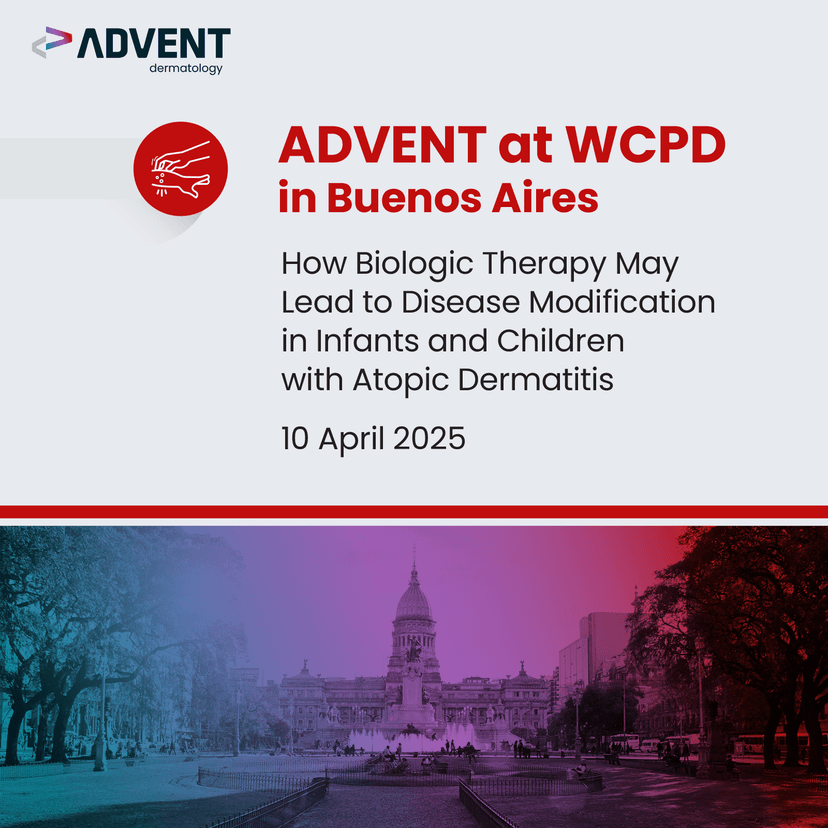
ADVENT at WCPD 2025
The ADVENT symposium at the 15th World Congress of Pediatric Dermatology (WCPD) will focus on discussions around disease modification in atopic dermatitis (AD) in three main topic areas: restoring the skin barrier, reducing non-atopic comorbidities, and stopping the atopic march in pediatric patients with AD aged 6 months to 11 years.

The Benefits of Early Intervention in Reducing the Burden of Disease in Children With Atopic Dermatitis
This page presents educational material, infographics, and video highlights from our recent ADVENT symposia, including the 2025 World Congress of Pediatric Dermatology (WCPD) in Buenos Aires, Argentina, exploring the pathophysiology of type 2 inflammation and atopic dermatitis, the burden of disease leading to cumulative life course impairment (CLCI), and the risk of the atopic march in pediatric patients with atopic dermatitis.
