This website is intended for healthcare professionals practicing in Romania.
The Summary Product Characteristics of Dupilumab is available here.
Dupilumab is dispensed on medical prescription type PR.
For the request of medical information, the reporting of adverse reactions and / or quality complaints, please call the call center service 24/7, phone (+40) 021 317 31 36, or contact us by email at the following addresses: ro.medical_info@sanofi.com - Medical Department, quality.ro@sanofi.com - Quality Department, pv.ro@sanofi.com - Pharmacovigilance Department.
You may also report adverse reactions to Sanofi medicinal products to the National Agency for Medicines and Medical Devices from Romania (NAMMDR); for details on reporting side effects, visit the NAMMDR website.

© 2026 Sanofi and Regeneron Pharmaceuticals, Inc.
All rights reserved.
MAT-GLB-2302957 - 4.0 - 10/2025
All Rights Reserved.
Sanofi and Regeneron are global leaders in pharmaceutical development, each with a long history of supporting frontline physicians to improve human health and reduce the burden of disease. Driven by the same commitment to patients and their families, Sanofi and Regeneron have partnered to take on type 2 inflammation and the range of chronic conditions in which excessive inflammation plays a role.

Type 2 inflammation can contribute to the pathophysiology of multiple chronic diseases, manifesting in the skin, airways or gastrointestinal tract. With the support of world experts in diseases involving type 2 inflammation, ADVENT has developed a multimedia medical educational platform to help advance clinical management and improve patient care.

ADVENT is a medical education program dedicated to Type 2 Inflammation across multiple therapeutic areas. Registering for ADVENT is free and unlocks unlimited access to exclusive features and a wealth of content relevant to the practice of Dermatology, Pulmonology, Rhinology, and Gastroenterology. Sign up now!


Watch on-demand expert soundbites recorded at the April 2025 ADVENT Forum in Lisbon, Portugal, featuring dermatology and immunology perspectives on mechanisms and clinical practice. Topics range from disease mechanism to patient care and quality of life, spanning atopic dermatitis (AD), prurigo nodularis (PN), chronic spontaneous urticaria (CSU) and bullous pemphigoid (BP).
The underlying pathophysiology of atopic dermatitis (AD) is driven by dysregulation of type 2 immunity that contributes to skin barrier dysfunction. AD typically develops very early in life and children with AD often develop other atopic conditions such as food allergy, asthma, and allergic rhinitis in a progression called the atopic march. Early treatment may help reduce the atopic march and other comorbidities to lessen the lifetime burden created by these diseases. There may even be a window of opportunity for disease modification.
Join Drs. Njira Lugogo, Simon Couillard, and Mario Castro for a session exploring the link between pathogenic mucus and impaired lung function in patients with moderate-to-severe asthma and the potential for disease modification with targeted therapy.
Join Professors Jean-David Bouaziz, Amy Paller, and Alan Irvine for a dynamic presentation on the multifaceted burden of atopic dermatitis, the evolving concept of disease modification, and how targeted systemic therapies may help improve long-term patient outcomes.
Join leading experts Miguel Lanz, Lakshi Aldredge, Angela Bretton, and Hilary Ugras in an engaging case-based discussion that explores the interconnected nature of chronic underlying type 2 inflammation and its profound impact across multiple diseases.

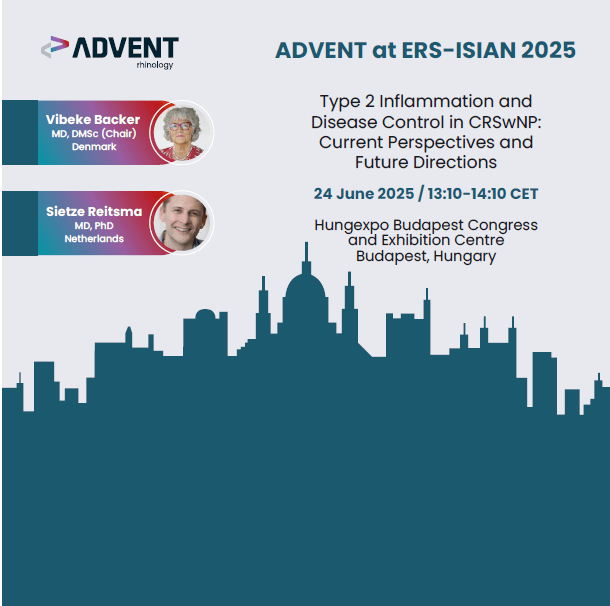
In this educational presentation, Profs. Vibeke Backer and Sietze Reitsma cover key aspects of type 2 inflammation and its role in the pathogenesis and management of CRSwNP and practical strategies for optimizing disease control and improving patient outcomes.
This page presents educational material, infographics, and video highlights from our recent ADVENT symposia, including the 2025 World Congress of Pediatric Dermatology (WCPD) in Buenos Aires, Argentina, exploring the pathophysiology of type 2 inflammation and atopic dermatitis, the burden of disease leading to cumulative life course impairment (CLCI), and the risk of the atopic march in pediatric patients with atopic dermatitis.

The March 2025 ADVENT symposium in Orlando, Florida brought together 4 dermatology experts to explore the evolving science of type 2 inflammation. Type 2 inflammation plays a central role in the pathophysiology of multiple dermatological diseases, driving chronic immune dysregulation that affects patients with atopic dermatitis (AD) prurigo nodularis (PN), chronic spontaneous urticaria (CSU) and bullous pemphigoid (BP). Understanding the mechanisms behind type 2 inflammation is key to advancing care and improving patient quality of life.